Experiential Team Building: What It Is and What to Book
Your CEO leans back and says, "Let's do something experiential this year." Everyone nods. Nobody in the room is sure what that means for the booking form.
Experiential team building is a facilitated session where a team tackles a challenge together, then talks through what happened and how they work. Toronto planners get this request more than you might think, and vendors use the word loosely enough that an escape room can wear it as a costume.
Here is the buyer's version: what you are actually paying for, how it compares to the usual suspects, and what to ask before you say yes.
What Experiential Team Building Actually Means (in Booking Terms) 🎯
Strip away the jargon and a real session has four parts:
- The challenge. A structured task designed so the team runs into a real dynamic, like unclear instructions or one voice dominating, in a setting where the stakes are low.
- The facilitator. A trained person who reads the room and steers it, not an enthusiastic emcee with a microphone.
- The conversation. A talk-through tied to how your team actually works, so the experience connects back to Monday.
- The takeaway. One or two things the team will try differently. If nobody can name one, nothing happened.
Why bother? Gallup's 2026 State of the Global Workplace report found just 20% of employees worldwide were engaged in 2025, with managers at only 22%. Want the research on why learning by doing sticks? Our post on why experiential learning works at work covers it. This one is about buying it well.
Experiential Team Building vs. the Other Options 🔍
A Visier survey of 1,000 U.S. employees found 24% did not feel connected to their coworkers. Fair question: which kind of event actually changes that?
- Escape room: Great energy, but one person usually cracks the puzzle while the rest watch. Without a facilitated debrief, nobody examines how the team worked.
- Bowling or happy hour: Relaxing and low effort. Also the same cliques in the same corners.
- Trivia night: Fun, and it rewards who knows facts, not who works well together.
- Lunch-and-learn or keynote: Useful information, very little practice.
- Experiential session: Built so the team practises a skill, then talks about it. Fun is the entry fee, not the product.
None of the others are bad. They just do different jobs. If the goal is relaxation, book the bowling. If the goal is a team that communicates better by March, book the session. Pick based on the job, and be honest with yourself about which one you have.
Experiential Team Building Activities: Pick the Problem First 🎯
Not sure where to start? Skip the activity catalogue and name the problem. Then match the session to it:
- People are not really talking to each other: a communication session built around listening and empathy.
- Nobody disagrees out loud: a psychological safety session, where speaking up gets practised with low stakes.
- The team is worn out after a rough stretch: a resilience session.
- Good ideas keep dying in meetings: an innovation session.
- Big group, short window: a game-show style session that keeps 200 people in it.
Most of these can be customized to your team, so you are not stuck with an off-the-shelf script.
What It Looks Like in the Room: Three Examples 🎲
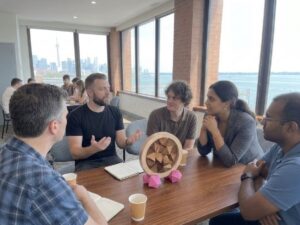
Here are three exercises from our communication sessions, and the question that opens the conversation afterward:
- The Empathy Build. A 30-plus minute blindfolded puzzle that small teams can only solve by truly understanding each other. Question: "Whose instructions only made sense to the person giving them?"
- Listen-Loop-Dip. An active-listening game where you earn your turn by showing you heard the last person. Question: "How many of this week's meetings worked this way?"
- Story Swap. Everyone shares a story and everyone listens. Question: "What did you learn about a colleague that no org chart could tell you?"
The activities change with the skill you are targeting. The shape does not: try it, notice it, name it, try again.
Experiential Team Building in Toronto: Fit, Timing and What to Ask 🍁
It suits more teams than people expect: new teams finding their feet, groups after a merger or reorg, leadership teams, and conference crowds of 200 or more. Our Teamwork PLAYshop is a good starting point, and it can be customized. Gallup estimates managers account for at least 70% of the variance in team engagement, which is why leadership teams are a smart place to start. Most sessions run two to four hours.
It is not the right tool for everything. If the real problem is workload, strategy or a broken process, a workshop will not fix it. A good provider will tell you that on the first call.
Before you book anyone, ask:
- "What will the team be able to do afterward?" If the answer is "have a great time", keep looking.
- "Who runs the conversation afterward, and how?" You want a trained facilitator, not a host.
- "How do you tailor it to our team?" A generic session fixes a generic problem. Yours is specific.
- "What happens after the session?" Look for follow-up activities or a simple habit the team can keep. Ours end with HomePlay, short follow-up activities that keep the new habit alive.
Our guide on how to choose a team building company goes deeper. Whether you run it in a Toronto boardroom or a hotel ballroom, FUNdamentals of Play is happy to be a sounding board.
Office Holiday Party Ideas in Toronto: When to Book 📅
December fills fast. A good rule is to start 6 to 10 weeks out for a facilitated event, which means that if you are reading this in late October, you are inside the window but not by much. Tight, not hopeless.
Our advice: pick the date first and the format second. A solid weekday afternoon in early-to-mid December beats a perfect idea on a date half the team cannot make. FUNdamentals of Play runs in-person events across Toronto and the GTA, so shortlist two options, check dates, and get a decision in front of leadership by the first week of November.
FAQ: Experiential Team Building
Ready to Try Team Building That Teaches Something? 🎉
If your team has done the escape room, the pizza and the trust falls, it is time for something that sticks. Our Teamwork PLAYshop is a great place to start, and we can customize it around the one skill your group needs most.
No pitch deck. No pressure. Just a really good conversation.
👉 Let's play. 🎉