Your Values Poster Is Not Your Culture: How a Team Culture Workshop Changes What Your Team Actually Does
There is a poster in the kitchen. It says Collaboration, Integrity and Fun in a very confident font. Down the hall, a meeting ends with everyone nodding, and four minutes later six private messages begin with "So... about that plan."
That gap is your culture. Not the poster. 😅
A team culture workshop is how you start closing it. Teams we work with in Toronto usually call after a reorg, a new leader, or a year where "fine" quietly became the most common answer in one-on-ones. Here is what a good one covers, when you can run it yourself, and what to ask before you book one.
What Is a Team Culture Workshop, Really? 🧭
A team culture workshop is a facilitated session where a team looks at how it actually works, names the unwritten rules, and agrees which ones to keep. It is not a values exercise. Values describe who you want to be. Culture is what happens when the deadline moves up and someone has bad news.
The stakes are real. After analysing 34 million employee profiles, MIT Sloan Management Review found that a toxic corporate culture was 10.4 times more powerful than compensation in predicting attrition. People will forgive a modest raise. They will not forgive being talked over every Monday for a year.
Good culture work is less about the big speech and more about small, repeated moments: who gets interrupted, how mistakes get handled, and whether "I disagree" is a career risk or a normal sentence.
Signs Your Team Needs a Culture Workshop 🚩
You do not need a full culture audit to know something is off. Watch for these:
- The meeting after the meeting. Real opinions show up in DMs, not in the room.
- The same three voices. Everyone else has quietly decided it is not worth it.
- Feedback that travels sideways. People tell a colleague what they should be telling the person.
- New hires learning the rules by breaking them. Nobody warned them, because nobody has ever said the rules out loud.
- A big change with no reset. New leader, merger, layoffs or a return to the office, and everyone is guessing at the new normal.
SHRM research on workplace culture found that one in five Americans had left a job in the previous five years because of its culture, and 58 percent of those who quit said their manager was the main reason. If two or more of the signs above sound familiar, our post on when team building is needed walks through the timing question.
What a Good Team Culture Workshop Covers 🧩
The best sessions move through three stages. Skip one and you get either a fun afternoon or a very long meeting.
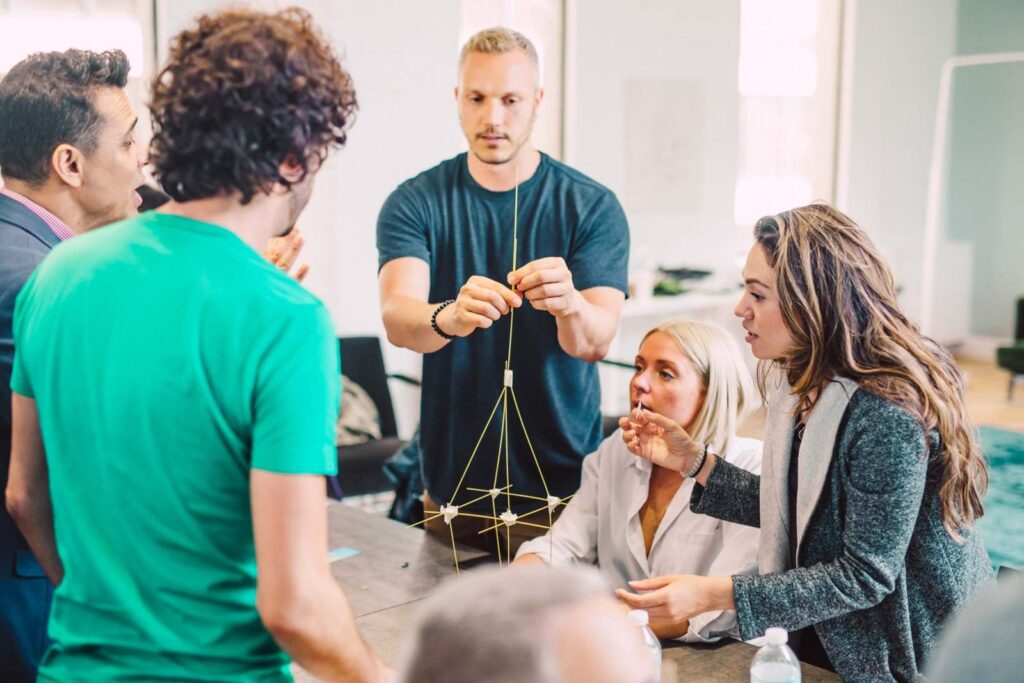
- Surface it. Start with a hands-on challenge that puts the team under a little friendly pressure. People stop performing and start behaving like themselves. Who takes charge? Who goes quiet? Who rescues the plan at the last minute?
- Name it. The debrief is where the culture work happens. A good facilitator connects what just happened in the game to what happens in Tuesday's project meeting, without turning it into a blame session.
- Agree on it. The team leaves with three to five working agreements in its own words, like "We disagree in the meeting, not after it." Short, specific and easy to notice when someone breaks one.
Psychological safety sits under all three. If people do not feel safe being honest, the workshop becomes a polite performance. Our guide to psychological safety activities has low-risk ways to build that first.
DIY Template or Facilitated Team Culture Workshop? ⚖️
Free templates exist, and some are good. Atlassian's Team Culture Retro is a solid structured format for a team that already trusts each other and just needs a better conversation.
DIY works when:
- Trust is already decent and the team needs a tune-up, not a rebuild.
- The leader can run the session without being the topic.
- The group is small, roughly under ten people.
Bring in a facilitator when:
- The leader is part of the pattern. It is hard to run an honest conversation about how decisions get made when you are the one making them.
- There is open tension, a recent merger, or layoffs.
- You need behaviour to change, not just a list on a whiteboard.
Gallup estimates that managers account for at least 70 percent of the variance in employee engagement. That is exactly why a neutral person in the room helps. The manager gets to participate, listen and be challenged, instead of running the show and wondering why everyone agrees with them. 🙃
Booking a Team Culture Workshop in Toronto 🍁
Toronto has plenty of workshops that are great fun and change nothing. Before you book, ask:
- "What will the team agree to by the end?" Look for working agreements, not a souvenir photo.
- "How will you adapt it to our situation?" A team after a reorg needs something different from a team that just doubled in size.
- "Will the leader take part?" The answer should be yes.
- "What happens in the 30 days after?" A five-minute check-in at the next team meeting beats a second workshop.
Most teams need 90 minutes to half a day for the session itself. The follow-up is what turns an event into culture. For the wider checklist, our guide to fun team building workshops in Toronto covers the red flags, and how to choose a team building company has five questions to ask before signing anything. You can also see how our sessions run on the FUNdamentals of Play homepage.
FAQ: Team Culture Workshops
Ready to Change How Your Team Actually Works? 🎉
If your values poster and your Tuesday meetings are telling two different stories, let us help close the gap. Our Teamwork PLAYshop is a great place to start, and we can customize it around your team, your culture challenges and your schedule
No pitch deck. No pressure. Just a really good conversation.
👉 Let's play. 🎉