Fun Professional Development: Why Your Team Learns More When They're Enjoying It
It is 2:15 on a Tuesday. The training session is in its second hour, in a boardroom with the blinds half closed. Slide 47 is up. Someone is answering email under the table, someone else has refilled their coffee three times just to stand up, and the facilitator just asked, “Any questions?” to a silent room.
Fun professional development sounds like a contradiction until you watch it work. If your Toronto team is sitting through learning that nobody remembers by Friday, the topic is rarely the problem. The format is. Here is how to build learning people show up for on purpose and use on Monday.
Fun Professional Development Is Not a Contradiction 🎯
Somewhere along the way, "professional" came to mean "quiet" and "development" came to mean "slides." Adults do not learn that way. They learn by trying something, getting it slightly wrong, and talking about it afterwards.
And your people want the learning. LinkedIn's 2019 Workplace Learning Report, as reported by CNBC, found that 94 percent of employees say they would stay at a company longer if it invested in helping them learn. Same people, same desire. They just do not want it delivered like a tax form.
Play helps it stick. In a sample of 2,500 games from The Training Arcade, ATD reports that 57 percent of players played three or more times, and players improved their knowledge by 58 percent between their first and third attempt. That study looked at digital games, not in-person workshops, but the lesson travels: people come back for learning that feels like play, and repetition is where skills get built.
Nobody has ever retaken a compliance quiz for fun. 😄
Here is the quiet cost of boring learning. People sit through it, tick the box, and go back to doing things exactly the way they did them before. The budget gets spent, the calendar gets filled, and nothing changes. Fun is not the opposite of rigour. It is how you keep the room awake long enough for the rigour to land.
What Professional Development Activities for Employees Need to Work 🧠
Fun is the wrapper. These are the parts that do the teaching:
- One skill, named up front. "Better communication" is a theme. "Ask a clarifying question before you answer" is a skill. Pick the skill.
- Doing, not listening. If the facilitator talks for most of the session, you bought a lecture with a nicer room.
- Low stakes, real feelings. A game lets people fail in ten minutes instead of ten months. The science behind that is in our guide to experiential learning in the workplace.
- A debrief that ties it to work. The game is the hook. The conversation afterwards is the training.
- A follow-up. One manager prompt a week for a month beats booking a second workshop.
Employee Development Activities That Teach Something Real 🧩
Here is how we match activities to skills:
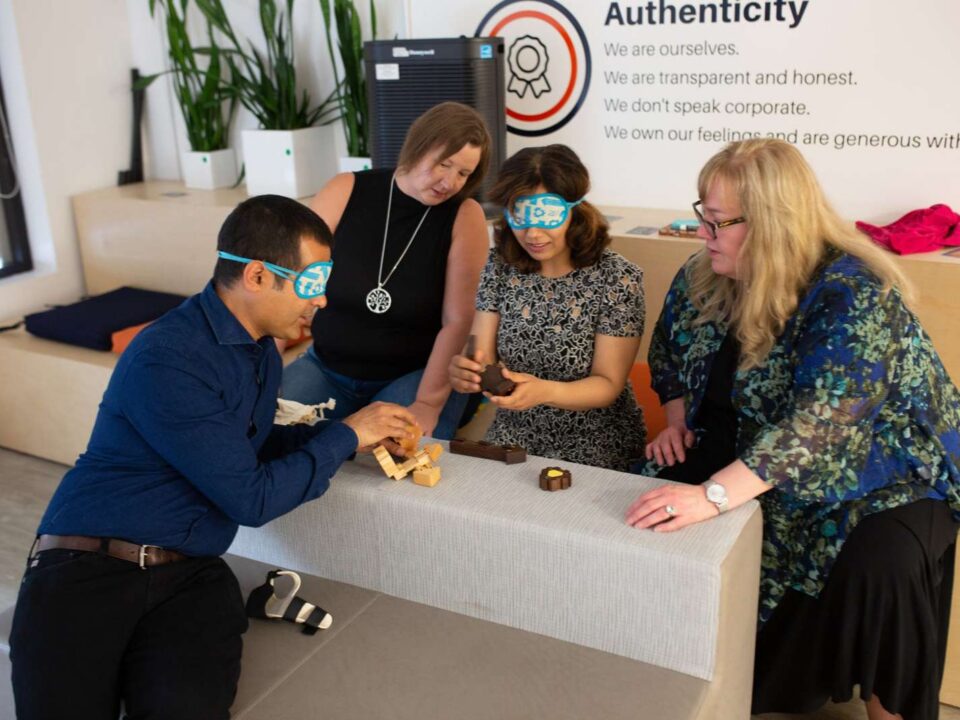
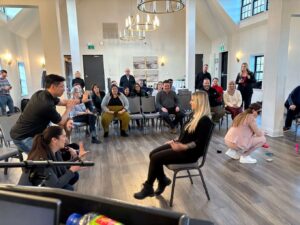
- Communication and empathy. The Empathy Build is a blindfolded puzzle that small groups can only solve by listening closely. Nobody has ever solved it by being the loudest.
- Storytelling and influence. Story Swap has everyone share a short story and everyone listen. Useful for anyone who has to explain a plan, a number or a "no."
- Creative problem solving. Games that reward fast, imperfect attempts teach people to start before they feel ready.
- A high-energy, playful session rebuilds energy after a hard quarter, which is exactly when learning is hardest.
If your goals sit closer to people skills, our page on mastering soft skills shows how we approach it. For managers, our Toronto leadership programs build on the same play-first method.
Professional Development Workshops in Toronto: What to Ask Before You Book 🍁
Toronto has no shortage of workshops. Teams we work with across the GTA tend to describe the last one the same way: fine, and forgettable. Before you book any facilitator, ask:
- "What will participants be able to do afterwards that they could not do before?" If the answer is "feel inspired," keep asking.
- "How much of the session is people doing something?" You want most of it.
- "How will you customize it to our team?" Generic content gets generic results.
- "What does follow-up look like?" Look for a plan, not a PDF.
Our guide to fun team building workshops in Toronto shows how to tell a workshop that teaches from one that only entertains.
How to Make the Case in Your Budget 💼
Professional development lives or dies in the budget meeting. Three things help. First, name the skill and the business problem it touches, such as slow handoffs or conflict that never gets resolved. Second, pick one or two simple measures before the workshop, like a short before and after self-rating or a manager check-in at 30 days. Third, report attendance and energy. When people show up willingly, that is the first result you can bring back to the table.
It also helps to let managers in on the plan. A manager who knows the skill being practised can notice it, name it and ask about it in the next one-on-one. That small habit does more for transfer than any slide ever will, and it costs nothing.
Keep the claims small and the follow-up visible. Year two gets easier. Want the full picture of how we run these sessions? Start on the FUNdamentals of Play homepage.
FAQ: Fun Professional Development
Ready for Professional Development People Look Forward To? 🎉
If your last round of training produced polite nods and no change in behaviour, let us help. Our Empathy and Communication PLAYshop is a great place to start, and we can customize it around your team's skills, goals and schedule.
No pitch deck. No pressure. Just a really good conversation.
👉 Let's play. 🎉