Why Attendees Skip Your Mixer, And How To Design Networking That Fills The Room Instead Of The Hallway
It is 10:15 a.m. The keynote just ended, 400 people have been released into the hallway, and every one of them has discovered something urgent on their phone. The coffee line is the only networking happening. The muffins are outperforming your mixer. 🧁
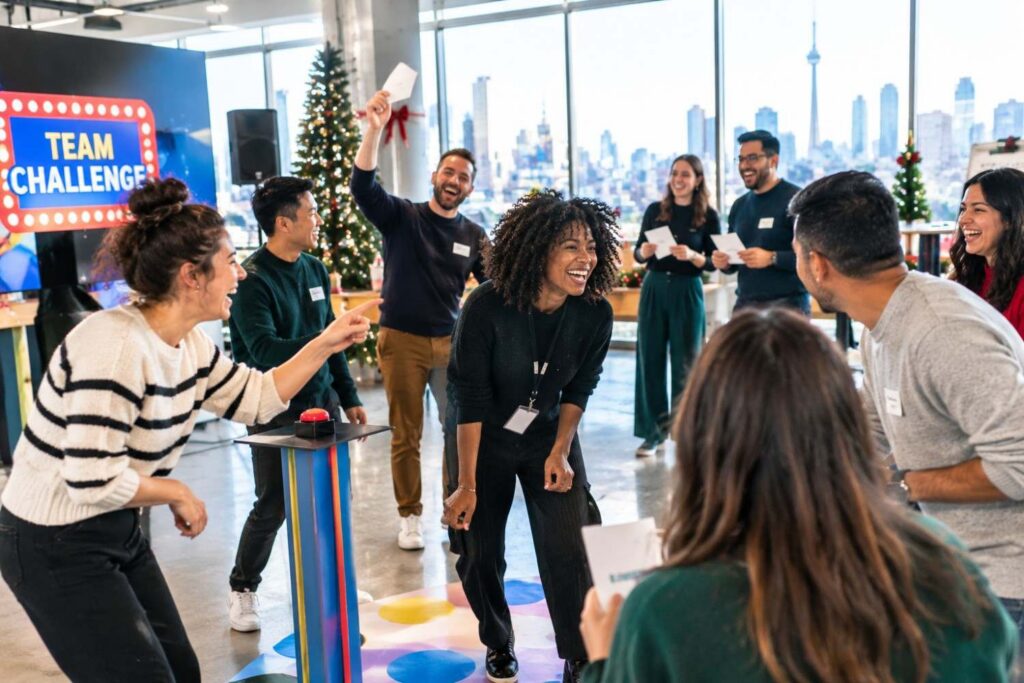
Good conference networking activities fix this, and they have less to do with ice than with structure. If you plan events for a Toronto organization, or you run HR for a team that is hosting one, this is the planner's version: what to run, when to run it, and why ten minutes in the first hour never works.
Attendees want this badly. A Cvent and Hanover Research survey of 1,000+ event attendees, summarized by MPI, found 52% name networking as their top reason to attend. We hand them a lanyard and a cheese plate.
Why Most Conference Networking Fails (It Is Not Your Attendees) 🙃
Walk the room at any conference break and you will see the same three things: colleagues clustered with colleagues, people studying their own badges, and one brave soul asking, "So, what do you do?"
That is a design problem, not an attendee problem. Lee Gimpel of Better Meetings, quoted in Associations Now, says attendees rarely name session content as the reason they came. They name collaborators, mentors and job leads. In his words, "people almost never say, 'My God, I loved the PowerPoint presentations.'"
Most agendas still give 90% of the day to content and leave networking the leftovers. Three patterns do most of the damage:
- Unstructured time. A "networking break" on the schedule is a wish, not a plan.
- No reason to talk. Strangers need a task, a question or a shared problem. Proximity alone does not do it.
- Too short, too early. Ten minutes before anyone has warmed up gets you ten minutes of phone-checking.
Conference Icebreakers vs. a Real Networking Session 🧊
Google Keyword Planner shows roughly 500 Canadian searches a month for conference icebreakers, so clearly planners are looking. A good icebreaker is useful. It is just not the same job as networking.
- The icebreaker: 5 to 10 minutes, whole room at once, low stakes, silly is allowed. Its job is to lower the temperature. Think Extremes, where people physically line up along a spectrum (early bird to night owl, say) and discover who is standing next to them.
- The networking session: 30 to 60 minutes, small groups, a prompt that goes past job titles, and a way to give something rather than take it. Its job is to create real connections and a reason to follow up.
Run the icebreaker to open the door. Run the session so people have somewhere to walk. That second job is exactly what our Authentic Networking PLAYshop is built around. If you only have time for one, pick the session. Our post on corporate networking activities covers six formats in detail. This one is about where they live on a conference agenda.
Conference Networking Ideas for the Opening Session 🚪
First impressions set the tone for three days. A few ideas that work before anyone has found their seat:
- Registration by interest. Associations Now suggests desks grouped by discipline, region or interest instead of one airport-style line. The first conversation happens in the queue.
- Badge prompts. Print an "ask me about" line or a top need on each badge. Instant conversation starters for people who hate starting conversations.
- Pairs invent a secret greeting, then use it every time they pass each other in the hallway. Ridiculous, and it works.
- The LevelUP Card Exchange. Each person shares a goal, a challenge and three gifts they can offer. It is the heart of our Authentic Networking PLAYshop, and it turns "what do you do?" into "how can we help each other?"
Keep the opener whole-room and under ten minutes. The deeper work belongs later.
Networking Activities for Large Groups: Think Pods, Not One Big Room 🎪
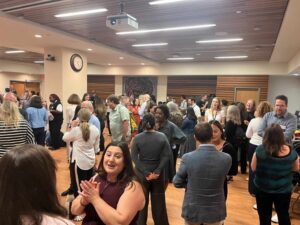
Between sessions is where big rooms go quiet. At 300 people, one giant circle is not an option. Think pods: tables of four to six, the same prompt running everywhere at once, facilitators moving between tables. Gimpel recommends groups of two or three, and one association workshop quoted in the same article used four or five. Small is the point. Our guide to team building activities for large groups covers the logistics of noise, sightlines and timing.
- Table prompts. One question per table that no résumé can answer. "What is a bad idea you are still proud of?" works better than it should.
- Speaker question cards. Seat people in small groups and have them write questions for the next speaker. It is networking disguised as homework, and speakers get better questions.
- Lead By Giving Exchanges. Timed rounds where people make introductions and share resources. Everyone arrives to give, not to take, and the room warms up fast.
Day Two Is Where Networking Quietly Dies 📅
By day two, attendees have found their people and stopped looking. Cliques set like concrete. The fix is to reshuffle on purpose:
- Reassign the seats. Group people by a new prompt, not by job function or company.
- Story Builder Circles. Small groups build a story one sentence at a time. It is silly, collaborative, and you learn how someone thinks in about four minutes.
- A reconnect round. Ask people to find someone they met on day one and share one thing they took away. Follow-up starts before the conference ends.
- A finale game. End with something loud and laughing so the last memory is not the coat check line.
For the wider conference program beyond networking, our earlier post on conference team building covers workshops, challenges and outdoor options.
Conference Networking Activities in Toronto: When to Bring In a Facilitator 🍁
Toronto conferences happen in hotel ballrooms, convention halls and rented lofts, and the room shapes the activity more than most planners expect. Low ceilings punish noisy games. Long narrow rooms punish circles. Pillars are, frankly, rude.
A facilitator earns their fee in three places: reading the room when energy dips, managing the handoff from icebreaker to session, and keeping 300 people moving without it turning into a game show. (If you do want a game show, we have one. It is called Recess.)
Our LevelUP Authentic Networking PLAYshop is built for exactly this, and it can be customized to your agenda, group size and room. Whoever you hire, ask three things: How do you run 200 or more people at once? What happens if the room is not ideal? How do attendees follow up afterward? If you would like a sounding board, FUNdamentals of Play is happy to be one.
FAQ: Conference Networking
Ready for Networking People Remember? 🎉
If your last conference ended with a quiet hallway and an untouched cheese plate, it is time to design the networking on purpose. Our LevelUP Authentic Networking PLAYshop is a great place to start, and we can customize it around your agenda, room and headcount.
No pitch deck. No pressure. Just a really good conversation.
👉 Let's play. 🎉